It was 2003, and I was on the way to New Zealand with a copy of The Lord of the Rings Location Guidebook in my bag and a map of Middle-earth in my head. I wanted to discover all the magical places I’d seen in the film.
Arriving into Christchurch, I started my journey on the South Island by crossing the Alps on the TranzAlpine train, from Christchurch to Greymouth. We stopped at the highest point, Arthur’s Pass. It was cold, silent and very still. In the film, unable to cross the snow-covered Mount Caradhras, the Fellowship descends into the mines of Moria… Our train was able cross, and we arrived in Greymouth with no loss of personnel!
I picked up my hire car and set off driving south. The west coast of the South Island has ridiculously dramatic contrasts, with glaciers giving way to lush green forest, and the forests bordering sandy beaches with crashing waves – all in the space of a couple of miles. At first, I would pull over and get out of the car to photograph the stunning scenery, but there was so much… soon I would just stop and wind down the window and still get amazing photos! Cate Blanchett (Galadriel) described New Zealand’s landscape as “so young, so savage, so untamed and unruly”, and Viggo Mortensen (Aragorn) described it as “an ideal, magical environment” – it made the perfect Middle-earth.
As I turned inland, the steep mountainsides seemed to be ‘crying’ with waterfalls after recent rain. There were forests draped with liana vines, looking like Lothlorien. All the pointy mountains looked like they’d had cloths draped over their peaks, and the cloth ran in sharp folds and gulleys… geologically young, without time for the elements to round and soften them. There was so much beautiful green freshness. The Māori spiral symbol, Koru, is shaped like an unfurling fern frond, and I spent plenty of time trying to photograph the perfect green spiral.
Another contrast was the landscape of the beautiful Lindis Pass. I was captivated by its austere beauty of the tussock grass. Its sun-bleached golden-brown tussock grasslands and rocky tors became Rohan in the film. I could imagine the Uruk-hai swarming over a hilltop, and the Rohirrim galloping across the grassy plains after the lighting of the beacons. And then there was Lake Tekapo – rightly one of the most photographed spots in New Zealand with a tiny stone church sitting on the shore of the almost impossibly turquoise lake.
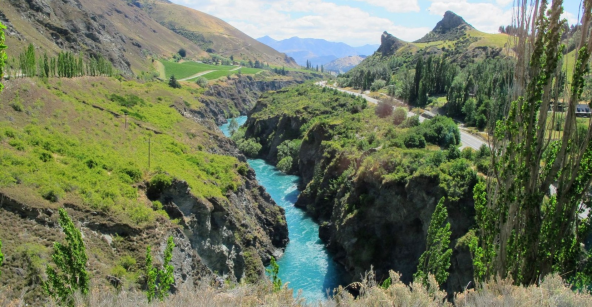
This journey brought me to the Central Otago wine region, framed by the snow-capped mountains of the Southern Alps and the jagged Remarkables mountain range near Queenstown. Pinot Noir was planted during the 1860s Gold Rush, but afterwards, the vineyards were converted back to orchards. It wasn’t until the early 1980s that the first commercial plantings of Pinot Noir were made in Central Otago by some pioneering winegrowers setting out on their quest...
It’s a land of extremes, with hot summers and cold winters. Another dramatic contrast – between daytime and nighttime temperatures – is key to Central Otago Pinot Noir. The Southern Alps to the west protect the region from the worst of the weather coming across the Tasman Sea, so there are plenty of dry, warm and sunny days that ripen the grapes and develop their concentrated flavours. But the altitude means that temperatures plumet at night, preserving bright acidity. Add to the mix the long, cool autumns and you have the potential for some fabulous flavour intensity.
I visited the Mount Difficulty winery. Yes, partly because it does sound like a mountain that could be in The Lord of the Rings! They had planted vineyards around Bannockburn in the early 1990s. The winery looks out over the vineyards, the rocky outcrops and tussock grass hills. The spiral logo on their bottles is laid into the bottom of a turquoise pool in front of the tasting room and restaurant – another excellent photo spot.
It was here that I first tasted the delicious, generous Pinot Noir that for me captured the vibrant, magical essence of The Lord of the Rings.
There was the bright, red berry fruit of the Shire, staining the lips of rosy-cheeked Hobbits. There was ripe, dark fruit like tangled bramble hedgerows in late summer. There was a smokiness, like the curling smoke from Gandalf’s pipe on Bilbo’s eleventy-first birthday. There was also a dark earthiness, reminding me of the earthy tree roots that the four Hobbits hide under once they’ve left the Shire, to escape the Nazgul. Frodo shouts "Get off the road!" and the terrifying dark riders pass inches away on the path above. There’s dark spice and fleshy notes, hinting at the evil creatures in the film – the Orcs and Uruk-hai. But there’s also savoury oak and elegant woody tannins, reminiscent of the graceful strength of the Ents, the tree-giants who help destroy Isengard. Then there was the texture - supple, smooth and silky – a texture reminding me the Elves, and the sinuous, twining carved beauty of Rivendell. And finally, my Central Otago Pinot Noir had the same qualities of purity and elegance as embodied by Galadriel in The Lord of the Rings.
Had I found the one grape to rule them all? I think I had.